
Many farmers grab whatever inflator is in the truck bed and assume it'll work. It often doesn't. The unit overheats, the pressure gauge lies, or the tire simply never reaches the pressure the manufacturer specifies for that load.
A tire inflator works for tractor tires only when its delivered air volume, pressure range, power source, and duty cycle actually match the tire and the job. This guide walks farmers, contractors, and dealers through what to check before buying, so you're not choosing equipment based on a flashy "150 PSI Max" sticker that tells you almost nothing about real-world performance.
Key Takeaways
- Judge inflators by delivered CFM at your working pressure, not the maximum PSI on the box.
- A 12-volt or cordless inflator suits occasional top-ups; frequent service or large tires need a higher-capacity compressor.
- Always use the tractor, tire, or implement manufacturer's specified pressure, never a number from another vehicle.
- Inspect tire, valve, hose, gauge, and connections before every inflation, and stop immediately if equipment overheats.
What Tractor Tires Require From an Air Tire Inflator
Tractor tire pressure isn't one-size-fits-all. It shifts based on tire size, load, ballast, terrain, and whatever implement is hanging off the back. Firestone's 2025 Ag Data Book illustrates this well: a 900/65R32 radial tractor tire is rated for 7,850 lbs at 6 psi, but jumps to 9,100 lbs at 9 psi in the same Firestone load table. Same tire, different job, different pressure.

Always check the tire or tractor manufacturer's published table for your exact size and load. Don't copy a number a neighbor mentioned.
Maximum PSI Doesn't Tell You Fill Speed
A compressor rated to "150 PSI max" says nothing about how fast it fills a large agricultural tire. VIAIR's agricultural equipment guidance is blunt about this: low airflow means slow inflation, even when the max pressure rating looks impressive on the box.
What actually matters is CFM (cubic feet per minute) delivered at a specific pressure:
- 4 CFM at 100 psi fills large ag tires slowly
- 13 CFM at 100 psi keeps pace with field and shop work
- Same max PSI on the box does not mean the same fill speed
Duty Cycle and Overheating Risk
Small compressors aren't built to run continuously. Duty cycle specifications describe how long a unit can run before it needs to cool down, and agricultural tires often demand more continuous run time than compact inflators are designed for.
Before buying, check:
- Rated duty cycle at your target pressure, not just at zero psi
- Thermal overload protection that shuts the unit off safely instead of letting it fail
- Recovery time between fill cycles
- Manufacturer tank-size limits — many compact units are rated only for small tanks, not full-size ag tires
Match Equipment to Use Case
- Occasional pressure checks on one tractor: a portable inflator may suffice
- Field repair refill: needs sustained airflow and higher volume
- Shop or fleet servicing: demands a higher-capacity, continuous-duty compressor
Match the accessories to the job as well:
- Hose long enough to reach around dual wheels
- Gauge readable in field light
- Valve adapters that fit your tractor's stems
Types of Air Tire Inflators for Tractors
Not every inflator category fits every job. Here's how the main options stack up:
| Type | Power Source | Best For | Limitation |
|---|---|---|---|
| 12V/24V portable inflator | Vehicle battery | Small top-ups, emergency field fixes | Short duty cycle, limited tank size |
| Cordless inflator | Battery pack | Light-duty tires, quick checks | Not specified for full-size ag tires |
| Standalone electric compressor | 120V/230V | Farm shop, repeated servicing | Requires grid power access |
| Engine-driven (gas) compressor | Gasoline engine | Remote sites, no power available | Heavier, needs fuel management |
| Shop air system | Fixed installation | Dealerships, high-volume service | Not portable |
When a Consumer-Style Inflator Falls Short
A small 12V unit can handle a quick top-up on a tire that's only slightly low. VIAIR's own agricultural-collection listing for its 100C model specifies a 9-minute maximum run time and notes it's designed for tanks no larger than 1 gallon, per VIAIR's product specifications. That run-time and tank limit means the unit isn't built to fill a large drive tire from flat.
If a tire has lost substantial air, or you're servicing multiple tires in a row, a small 12V inflator will likely overheat before the job's done.
Portable Compressors for Field and Farm Work
For contractors and farmers moving between fields or service trucks, a mid-size portable electric or gas-driven compressor often bridges the gap. John Deere's published home workshop line gives useful reference points for what "portable" actually delivers:
- 120V electric unit: 4.1 CFM at 100 psi
- Gasoline-driven model: 13.1 CFM at 100 psi
Stationary Shop Compressors for Dealers
Dealerships and farm workshops servicing multiple tractors, dual wheels, and other equipment usually need more than portable gear. A stationary shop compressor with a larger tank and higher CFM output reduces wait time between jobs and handles back-to-back inflations without overheating.
Battery vs. Corded: Cold-Weather Considerations
Battery-powered units offer mobility but lose performance in cold weather; most manufacturers advise warming batteries before use in low temperatures. Corded or vehicle-powered systems avoid that issue but tie you to a power source or outlet.
Inflators vs. Wheel-Handling Equipment
An air compressor fills the tire. It doesn't help you get the wheel off, hold it steady, or line up lug nuts safely. That's a separate job.
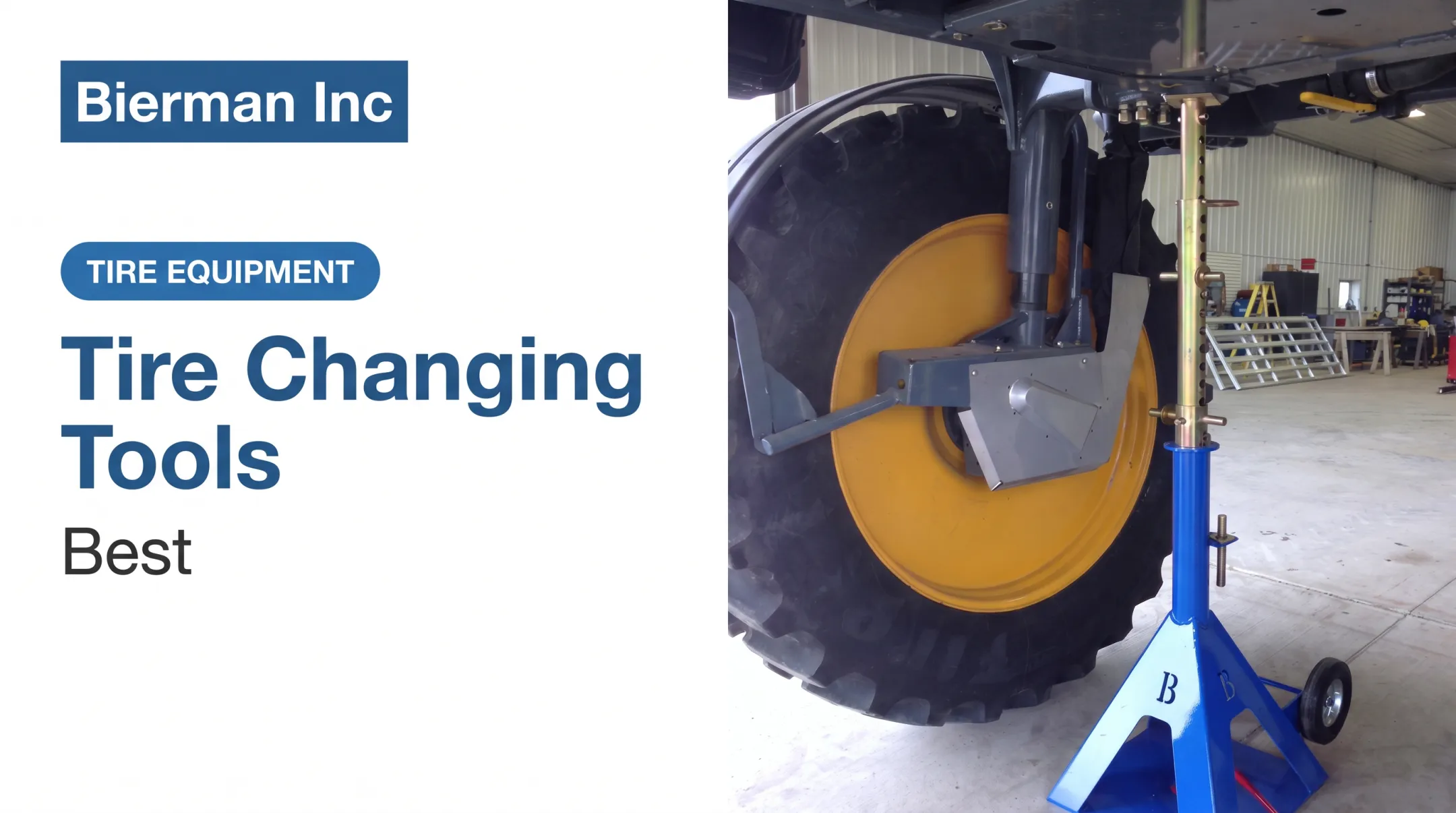
This is where equipment like Bierman Inc's EZ Dual Changer fits in. It's a patented (Patent No. 9,695,020) tool built for holding, rotating, and aligning agricultural dual wheels, so one person can change duals in about five minutes without removing the tractor's equipment.
It hangs from a chain hoist, front-end loader, or service truck boom, and handles tires up to 32 inches wide with a 3,000-pound lift capacity.

The EZ Dual Changer supports wheel changes; it doesn't replace an air compressor or inflator. You'll still need proper inflation equipment once the wheel is mounted.
How to Choose and Use the Right Inflator
Work through this sequence before you buy anything:
- Identify your largest tire. The biggest tire you'll service sets your minimum requirement. Don't size equipment around your smallest tire.
- Confirm manufacturer-recommended pressure from the tire or tractor documentation, not a generic number.
- Estimate inflation frequency. Occasional top-ups need less capacity than daily shop use.
- Compare CFM at working pressure, duty cycle, and power source across candidate units.

Reading a Spec Sheet Correctly
Product listings throw a lot of numbers at you. Here's what each one actually means:
- Max PSI: the ceiling pressure the unit can reach, not how fast it gets there
- CFM at pressure: the number that actually predicts fill time (always check what pressure it's measured at)
- Tank size: buffers demand between compressor cycles
- Motor horsepower: a rough proxy for output, but less reliable than CFM
- Duty cycle / recovery time: how long it runs before needing a break
If a listing doesn't specify CFM at a stated pressure, treat that as a red flag and look for a more transparent spec sheet.
Recommendations by Role
Match the unit to how you work:
- Working farmer: Prioritize mobility and simplicity. A portable electric or gas-driven compressor covers most seasonal needs without shop installation.
- Custom operator or contractor: Field access matters most. Look for gas-driven or battery-based options that don't depend on finding an outlet mid-job.
- Ag dealer: Volume and uptime matter more than portability. A stationary shop compressor with higher CFM cuts downtime across multiple jobs per day.
Safe Inflation Workflow
- Park on stable, level ground and secure the tractor so it can't roll
- Let the tire cool if it's been in heavy use; heat skews gauge readings
- Inspect the tire, valve, and rim for visible damage before adding air
- Connect the hose securely with the correct valve adapter
- Inflate in controlled stages, checking pressure with a trusted gauge as you go
- Recheck pressure after the tire settles, then adjust for load, terrain, or seasonal temperature swings
Fendt's VarioGrip system makes the same point in factory form: an onboard compressor stores separate field and road pressure settings so the operator can switch without guesswork. Most farms won't run an integrated system, but the principle still applies when you set pressures by hand.
Safety, Maintenance, and Field-Readiness
Inflation carries real risk, especially with multi-piece rims. Never inflate a visibly damaged tire, and never stand in the tire's trajectory zone during inflation.
OSHA's rim-wheel standard (29 CFR 1910.177) specifies restraining devices for multi-piece rim wheels and requires enough hose length that the technician can stand outside the potential trajectory zone during inflation. A failed rim assembly can travel with significant force, so that standoff distance is not optional.
The rule does not automatically cover every farm workplace. The safety logic still applies: stay clear of the blast path, regardless of which regulation governs your operation.
Routine Equipment Checks
- Hoses and chucks — look for cracks, leaks, or worn threads
- Gauges — verify accuracy periodically against a known reference
- Electrical cords and batteries — check for fraying or swelling
- Air filters and tanks — oil-lubricated compressors need more frequent oil service than oil-free units; both need intake filter attention
- Pressure-relief valves — don't use them as a routine drain method; follow the manufacturer's specific drain procedure instead
Field-Readiness Checklist
- Charged batteries or fueled engine
- Extension hoses long enough for dual-wheel access
- Correct valve adapters on hand
- A gauge you trust
- A plan for managing heat buildup during extended use
Storage and Seasonal Care
Protect equipment from moisture, dust, and temperature extremes. Condensate left in a compressor tank can freeze in cold storage, so drain tanks before winter and store batteries somewhere temperature-stable, not in an unheated truck bed all season.
Frequently Asked Questions
What size air compressor do I need for tractor tires?
Match the compressor to your largest tire, target pressure, and how often you inflate. Use delivered CFM at working pressure against the tractor and tire maker's specs—not max PSI alone.
What is the best air compressor for farm use?
Portable units work for occasional field top-ups; shop or engine-driven compressors handle repeated servicing better. Choose based on your largest tire and how often you're doing this job, not a single "best" model.
Can a 12-volt tire inflator inflate a tractor tire?
Some can handle a limited top-up if their duty cycle and CFM specs support it. Many consumer-grade units overheat or run too slow for large agricultural tires that have lost significant air.
What specifications matter most when choosing a tractor tire inflator?
Prioritize delivered CFM at working pressure, duty cycle, power source, hose/valve fit, thermal protection, and gauge accuracy. Max PSI alone tells you almost nothing useful.
How do I safely inflate a tractor tire?
Inspect the tire and valve, then use the manufacturer's recommended pressure. Secure connections, inflate in controlled stages, and stand clear of the tire's trajectory zone. Stop immediately if you notice damage or unusual heat.