
Introduction
U.S. farms are running leaner than ever. Labor is harder to find, input costs keep climbing, and unpredictable weather is squeezing planting and harvest windows tighter each year. Many operators are asking the same question: how do you produce more with fewer hands and less margin for error?
Modern agriculture equipment answers that question differently than it did a decade ago. Today's machines pair mechanical horsepower with GPS guidance, sensors, and automation that help farmers make faster, better-informed decisions.
This guide breaks down the top 10 categories of modern farm equipment, from tractors to wheel-handling tools. There is no single best machine—the right fit depends on your acreage, crops, labor situation, and total cost of ownership.
Key Takeaways
- Match the tool to the job: core machines (tractors, planters, harvesters) plus tech (drones, sensors, autonomy)
- Buy for a real bottleneck—planting accuracy, harvest speed, water use, or crop protection
- Weigh compatibility, service support, and maintenance costs alongside sticker price
- Adopt new tech for a measurable need, not because it’s newest on the lot
Overview of Modern Agriculture Equipment in the U.S.
Modern agriculture equipment covers three layers that work together:
- Primary machines: tractors and combines that supply power in the field
- Implements: planters, sprayers, and tillage tools that attach to those machines
- Digital technologies: GPS receivers, telematics, and farm-management software that guide or monitor the work
A tractor without a planter can't seed a field. A planter without GPS guidance can't hold row spacing across long runs.
The U.S. market isn't one-size-fits-all. Large row-crop operations in Iowa or Illinois need different horsepower and technology than a specialty vegetable farm in California or a cattle operation in Texas. Custom operators and smaller farms often mechanize differently, too, leaning on shared equipment or targeted implements rather than full fleets.
Adoption of precision tools is already high on larger farms. According to USDA's Economic Research Service, guidance autosteering was used by 52% of midsize and 70% of large-scale crop-producing farms in 2023, and 68% of large-scale operations used yield monitors or soil maps. Rates still vary widely by farm size and technology type.

The categories below cover the equipment types most farms use directly for power, precision, protection, and logistics.
Top 10 Modern Agriculture Equipment
Each category below is evaluated on core function, modern capabilities, real limitations, and the type of farm most likely to benefit. Specifications and features are drawn from current manufacturer documentation and university extension research.
1. Tractors
Tractors remain the workhorse of most farm operations. They pull implements, deliver hydraulic and PTO power, haul materials, and handle everything from tillage to mowing. Few single machines touch as many jobs on a farm calendar.
Modern tractors add GPS guidance, auto-steer, telematics, variable-rate control, and improved cab visibility. John Deere's 8R 250, for example, delivers 247 rated horsepower with a hydraulic pump rated at 60 gpm standard (84 gpm optional), while compact models like Kubota's L02 series range from roughly 33 to 48 gross horsepower for smaller operations.
Specs worth comparing:
- Horsepower and lift capacity relative to your implements
- Hydraulic flow (gpm) matched to attachment demand
- Transmission type and tire or track configuration
- Telematics and data-sharing terms (Deere's JDLink and Operations Center, for instance, collect machine-health and field data separately)
Trade-offs include purchase price, fuel use, soil compaction risk on wet ground, and operator training for newer touchscreen systems.
2. Precision Planters and Seeders
Planters and seeders control seed spacing and depth, which supports more even emergence and less wasted seed. Row-crop planters, grain drills, pneumatic systems, and specialty planting equipment serve different crops and field conditions.
Modern planters add electronic seed meters, variable-rate control, downforce management, section control, and real-time seed monitoring. Downforce settings matter more than many buyers expect.
A University of Maryland research-center trial found irrigated corn yielded 189 bushels per acre at 20 psi downforce, versus 179 bu/acre at 30 psi and 141 bu/acre at 10 psi, at that specific site. Iowa State Extension recommends checking the seed trench and adjusting downforce as soil conditions change within a field rather than setting it once and forgetting it.

Snapshot for comparison:
- Crop compatibility and row-spacing needs
- Required tractor hydraulic and hitch capacity
- Section control and variable-rate features
- Fertilizer or starter integration options
Treat any yield claim as site-specific. What worked in a research trial won't automatically transfer to your soil type.
3. Harvesters and Combines
Combines, forage harvesters, and specialty machines shorten harvest windows and cut dependence on manual labor at the busiest time of year. Header options, threshing systems, and residue management vary by crop and terrain.
Newer models add grain-quality sensing and automation. Deere's HarvestLab 3000 Grain Sensing, available on model-year 2025 and newer X9, S7, and T6 combines, records crop moisture and constituents like protein, starch, and oil directly into Operations Center. Automatic header raising and lowering at set field triggers is also part of that 2025 update.
What to check before buying:
- Crop types and throughput capacity needed
- Terrain and field size requirements
- Grain-handling and storage compatibility
- Dealer parts availability and service response time
Uptime is everything during harvest. A combine that saves an hour a day doesn't help if it's parked for three days waiting on a part.
4. Irrigation Systems and Smart Water Equipment
Drip, sprinkler, center-pivot, subsurface, and pump-based systems each fit different field layouts and water sources. Sensor-controlled and automated systems are becoming more common as water costs and regulations tighten.
Variable-rate irrigation (VRI) adjusts water application based on soil variability across a field. A two-year USDA Agricultural Research Service study in Mississippi found VRI used 25% less irrigation water than uniform application, with no statistically significant yield difference in corn and soybeans.

University of Minnesota Extension notes that VRI mainly pays off on fields with real soil variability; uniform fields may see little benefit from the added cost.
Comparison points:
- Water source, pressure, and flow requirements
- Field size and crop layout
- Automation level (soil-moisture sensors, remote monitoring)
- Local water regulations, such as California's groundwater sustainability planning requirements in certain basins
Always confirm current agronomic and water-use rules before designing a system for your region.
5. Sprayers and Precision Crop-Protection Equipment
Tractor-mounted, self-propelled, and targeted sprayers apply crop-protection products and nutrients with far more precision than older boom systems. GPS section control, automatic boom height, and rate control cut down on overlap and waste.
Deere's ExactApply system controls individual nozzles to maintain target rate and pressure, which the manufacturer describes as helping reduce overapplication and off-target drift. Pulse-width modulation, as North Dakota State Extension explains, lets operators control nozzle flow and pressure independently for finer application control.
Snapshot:
- Tank capacity and boom width for your acreage
- Terrain suitability and calibration frequency
- Operator protection and maintenance access
- Compatibility with existing rate-controller software
Drones can supplement spraying in some operations, but FAA rules require additional authorization beyond a standard Part 107 license for agricultural dispensing, including an Agricultural Aircraft Operator Certificate.
State pesticide-applicator licensing, like Texas's requirement for commercial aerial application, adds another layer. Verify federal, state, and label requirements before buying.
6. Autonomous and Robotic Farm Equipment
Autonomous tractors, robotic weeders, and automated field platforms use GPS, machine vision, and AI to handle repetitive tasks without constant operator input. Some are supervised remotely; none currently run fully unattended across every job.
Deere identifies tillage as the first supported task for its autonomous tractor solution, requiring smartphone or tablet monitoring, obstacle alerts, and live video access. The company's own product page notes availability may be limited, meaning this isn't yet a walk-into-any-dealer purchase.
Snapshot:
- Task suitability (tillage first, others expanding)
- Connectivity requirements for remote monitoring
- Field conditions and terrain regularity needed
- Integration with existing tractors and implements
Limitations include high upfront cost, dependence on reliable connectivity, and reduced suitability on irregular terrain. AEM has noted that weak signal or poor weather can interrupt connected field operations.
7. Drones, Remote-Sensing Systems, and Crop-Scouting Equipment
Drones and remote-sensing tools support field mapping, stand assessment, and stress detection. Visual, multispectral, thermal, and satellite-supported sensing each serve different purposes, but data always needs field validation.
University of Delaware Extension points out that basic aerial photos can already reveal nutrient, pest, and irrigation problems worth investigating further. Multispectral equipment isn't necessary for basic scouting; it adds value for more targeted diagnostics.
Adoption context: USDA ERS measured imagery from aircraft, drones, and satellites combined on just 7.0% of corn acreage in 2016 and 9.8% of soybean acreage in 2018, meaning this technology is still far from universal.
Snapshot:
- Sensor type matched to the question you're asking
- Coverage area and image resolution needs
- Weather limitations for flight scheduling
- Integration with existing farm-management software
Commercial flights require FAA Part 107 registration and Remote ID compliance; some conditions require waivers.
8. Connected Farm Sensors and Fleet-Management Systems
Soil-moisture sensors, weather stations, equipment telematics, and centralized management platforms feed data into decisions about maintenance, fuel use, and field records. The value comes from acting on the data, not just collecting it.
USDA NASS reports 85% of U.S. farms had internet access in 2025, which sets the stage for connectivity but doesn't tell you how many are actually using telematics or IoT sensors day to day.
Snapshot:
- Data sources and connectivity reliability
- Software compatibility with existing systems
- Data ownership terms (Deere's Farmer Data Commitment, for example, lets farmers control third-party sharing)
- Subscription costs and staff training needs
The Ag Data Transparent principles, developed with the American Farm Bureau Federation, are a useful checklist for reviewing any vendor's data contract before signing.
9. Electric, Hybrid, and Alternative-Power Agricultural Equipment
Battery-electric compact tractors and utility vehicles are moving from pilot projects to working equipment on some operations. Lower noise and reduced local emissions are real advantages; total operating-cost savings depend heavily on duty cycle and electricity rates.
Monarch's MK-V specifies 40 hp rated, 70 hp peak, and up to 14 hours of runtime, varying by task and implement, with charge times of 5 hours at 80 amps or 10 hours at 40 amps.

University of California research and extension centers reported deploying electric tractors at seven of nine locations, with roughly five hours of use-dependent runtime.
Snapshot:
- Duty cycle and power demand for your typical jobs
- Charging infrastructure and downtime tolerance
- Cold-weather battery performance
- Payload and available service support
Runtime numbers vary by operation. Match the spec sheet to your actual workload, not the marketing headline.
10. Wheel-Handling, Lifting, and Material-Transport Equipment
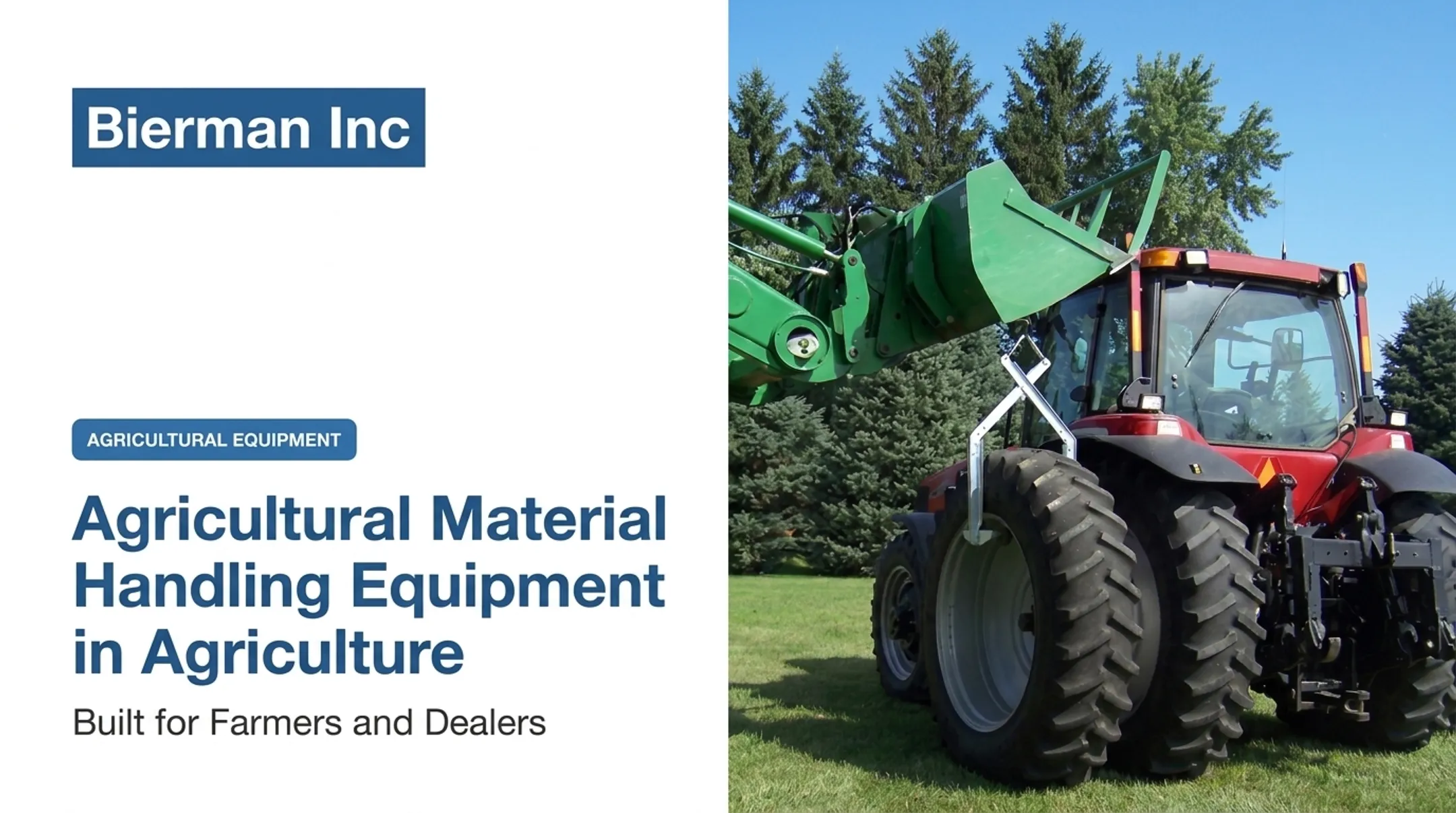
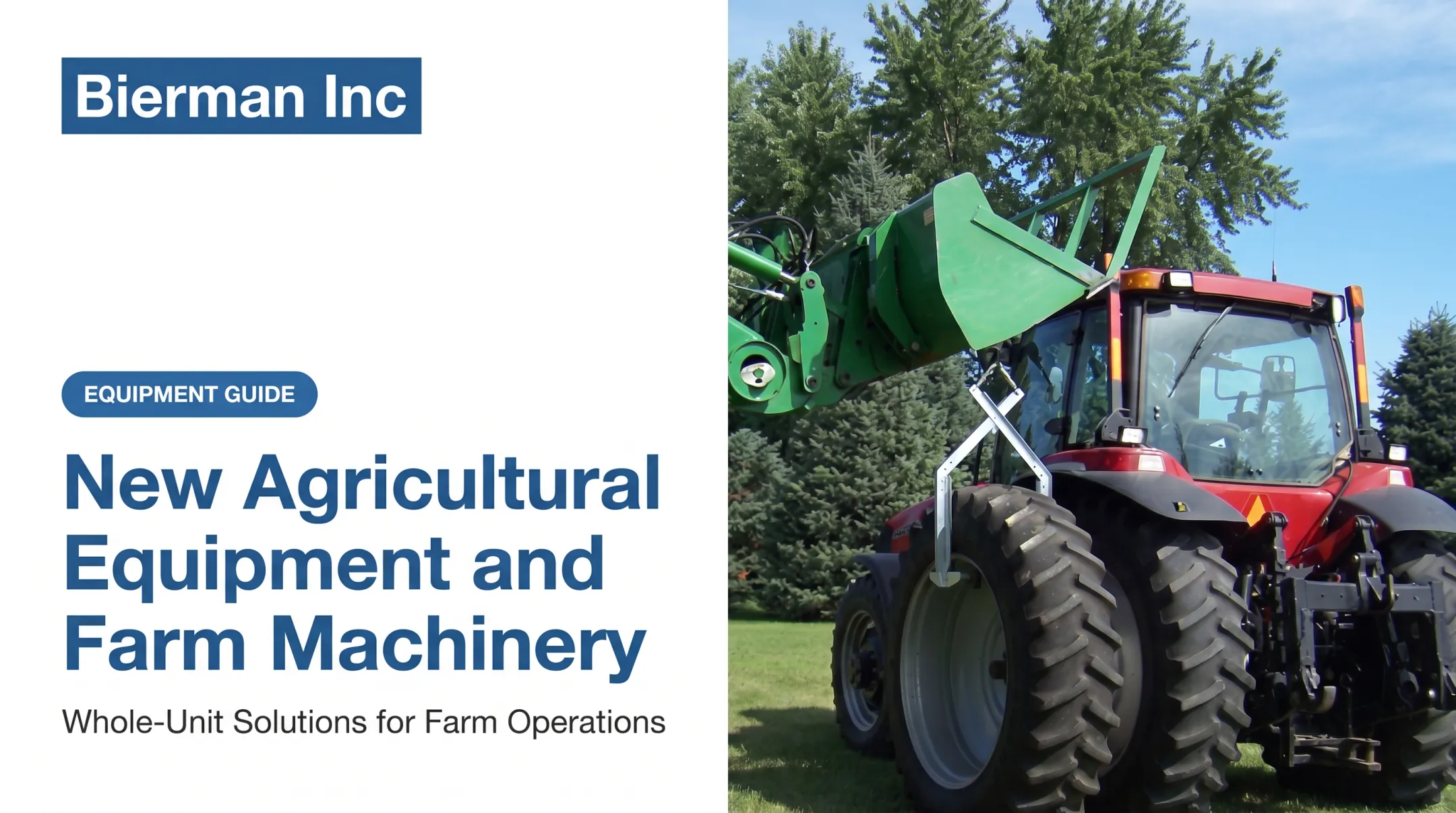
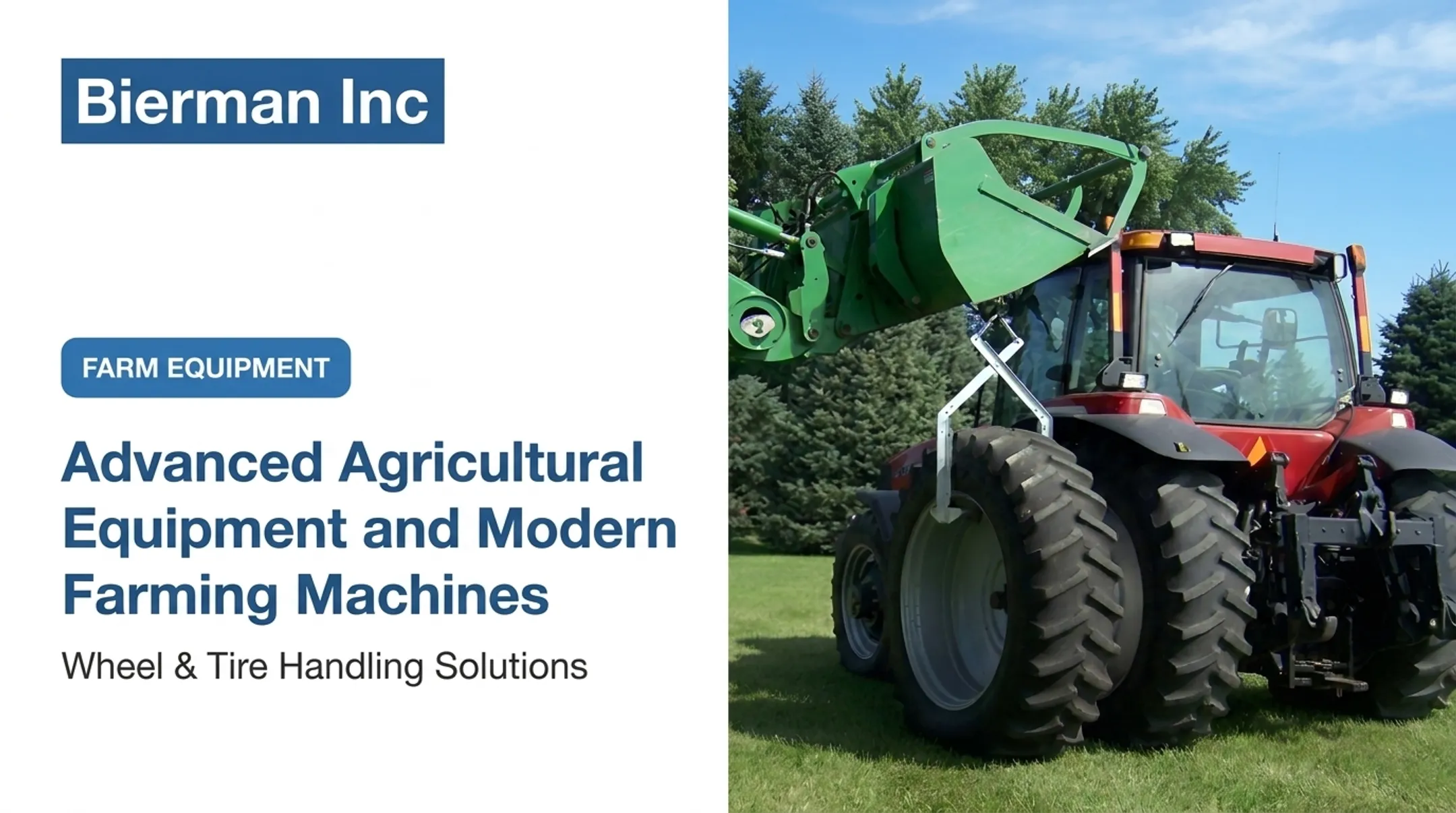
Loaders, telehandlers, trailers, and wheel-handling tools move heavy loads safely around a farm or dealership. This category gets less attention than tractors or drones, but changing a single ag dual tire without the right equipment can be a two-person, half-day job involving serious crush and pinch hazards.
Selection factors:
- Rated capacity matched to wheel or load weight
- Attachment compatibility with existing loaders or forklifts
- Stability and operator safety features
- Storage footprint and maneuverability
Bierman Inc's EZ Dual Changer is a specialized example built for this exact job. Covered under Patent No. 9,695,020, it is designed to let one person change agricultural dual tires in about five minutes, without removing wheel weights first.

EZ Dual Changer specs:
- Tire sizes from 14.9 to 32 inches; capacity up to 3,000 pounds
- Pricing roughly $450–$880 by model, plus a one-year warranty on materials and workmanship
- Suspends from a chain hoist, front-end loader, forklift, or service truck boom
For heavier loads, options like an industrial wheel mover (handling 320 to 1150 metric tires and up to 4,000 pounds) or a hydraulic wheel dolly rated to 3,800 pounds cover semi tires through 800 metric wheels. Always verify current specifications with the manufacturer before purchase.
How We Chose the Best Modern Agriculture Equipment
"Best" here means best suited to a defined need, not necessarily the newest or most expensive option on the market. Evaluation criteria included:
- Operational fit – farm size, crop type, soil and terrain, annual usage hours, and labor availability
- Compatibility – whether the equipment works with tractors or implements you already own
- Total cost of ownership – purchase or financing cost, fuel, labor, maintenance, parts, software subscriptions, and resale value
- Practical technology value – whether GPS, automation, or sensors actually produce a usable decision, not just more data
- Support infrastructure – dealer coverage, parts availability, training, and warranty terms
On total cost, Iowa State Extension's farm-machinery worksheet separates operating costs (repairs, fuel, labor) from ownership costs (depreciation, taxes, interest, insurance). That split is a useful framework for any equipment comparison.
Common purchasing mistakes to avoid:
- Buying more capacity than your acreage or crop mix requires
- Ignoring soil compaction risk with larger, heavier machines
- Overlooking attachment or hydraulic compatibility before buying
- Trusting productivity claims that came from a single research trial, not your own conditions
- Skipping a maintenance and operator-training plan
Conclusion
Modern agriculture equipment now spans everything from 500-horsepower tractors to soil sensors the size of a phone. The strongest investment is the machine or tool that fixes a bottleneck you can measure on your operation.
Before buying new or used equipment, compare:
- Capacity and compatibility with your current fleet
- Safety features and available service support
- Lifecycle cost and upgrade path
For farms, custom operators, and dealers handling heavy dual wheels, Bierman Inc's EZ Dual Changer is built for safer, faster wheel changes. Contact Bierman Inc to verify current specifications and product availability for your operation.
Frequently Asked Questions
What are the trends in agricultural machinery?
Automation, precision guidance, connectivity, and electric or alternative-power options are the main trends. Adoption still varies by farm size and equipment type, so check current USDA data before assuming a technology is standard.
What is the latest technology in agriculture?
The newest tools only pay off when they fit your fields and existing setup. AI-assisted machinery, autonomous tractors, variable-rate systems, drones, telematics, and automated irrigation lead the list.
What is the most important piece of equipment on a modern farm?
Tractors are usually the central power unit, but the most important machine still depends on your crop, acreage, and biggest bottleneck—planting speed, harvest capacity, or water management.
Is modern agricultural equipment suitable for small farms?
Yes. Compact tractors, used machinery, targeted implements, sensors, and custom-hire services let smaller operations access modern capabilities without building a full large-scale equipment fleet.
What should farmers consider when buying agricultural equipment?
Match the machine to the job, capacity needs, and your current lineup first. Then weigh total cost of ownership, parts and service access, safety features, financing, and operator training before you buy.
How is autonomous equipment changing agriculture?
Autonomy can automate repetitive tasks like tillage and help offset labor shortages, but current systems still require remote supervision, reliable connectivity, and work best on regular terrain rather than every field condition.