
Introduction
Every pound your truck, tractor, or combine carries passes through small rubber contact patches on the ground. Tires and wheels decide whether you stop safely, pull a load efficiently, or end up stranded with a blown sidewall in the middle of a field.
Most operators run into the same headaches: cryptic sidewall codes that read like a secret alphabet, wheels that don't quite fit the hub, tread that wears unevenly for no obvious reason, and the physical risk of wrestling an 800-pound dual assembly off a tractor axle.
This guide breaks down what tires and wheels are actually made of, how to read the codes stamped into every sidewall, the fitment math that keeps a wheel from rubbing your suspension, routine maintenance habits, and the specialized equipment that makes heavy agricultural wheel changes manageable for one person instead of three.
Key Takeaways
- Sidewall codes like P225/65R17 encode width, aspect ratio, construction, and rim diameter; misread one and the tire won't fit
- Replacement load index and speed rating must meet or exceed OEM specs, never fall below them
- Bolt pattern, offset, and center bore, not just overall diameter, determine true wheel fitment
- Rotate passenger tires every 5,000-7,500 miles and inspect monthly for uneven wear
- A single 18.4" × 46" agricultural dual can weigh roughly 840 pounds—handling gear exists for a reason
The Anatomy of Tires and Wheels: Definitions and Core Components
People use "tire," "wheel," and "rim" interchangeably, but they're three different things. A tire is the flexible rubber casing that holds air and grips the road. A wheel is the rigid metal assembly that mounts to the axle and carries the load. The rim is just the outer edge of the wheel — the lip where the tire bead actually seats. Calling the whole wheel a "rim" is common shorthand. That habit muddies conversations with a parts counter or service tech.
Core Components of a Tire
Peel back a tire and you'll find several engineered layers working together:
- Inner liner: an airtight rubber layer that keeps pressure sealed inside
- Body plies: textile cords that give the casing its strength and shape
- Steel belts: stabilizing layers beneath the tread that resist punctures and squirm
- Beads: steel-wire bundles that clamp the tire firmly onto the rim
- Sidewall: the flexing outer wall that protects the casing from curb strikes and impacts
- Tread: the rubber compound and pattern that contacts the road
Those layers only work as intended when the rubber compound matches the job:
- Passenger all-season: year-round grip across varying temperatures
- Commercial truck: casing durability for high mileage
- Agricultural traction: cut-resistant tread and curved, multi-angle lugs for pull in soft soil
One compound does not fit all three jobs. Match the tire to the duty, not the other way around.
Core Components of a Wheel
The wheel side of the assembly has its own vocabulary:
- Center bore: the opening that centers the wheel on the hub
- Hub mounting surface: where the wheel presses flush against the axle hub
- Wheel face/spokes: the visible front structure (solid disc or spoked)
- Barrel: the cylindrical body between the two bead seats
- Rim lip: the flange that helps retain the tire bead
Material choice matters more than most people realize. Alcoa reports that a forged-aluminum 22.5 x 8.25-inch wheel weighs roughly 39 pounds, compared to 68-82 pounds for an equivalent steel wheel, with aluminum dissipating heat faster while steel carries a lower upfront price.

- Aluminum: lower unsprung weight, faster heat dissipation, potential fuel-economy gain on fleet trucks
- Steel: lower upfront price and an edge in raw durability when weight savings matter less
Decoding Tire Markings: Sizing, Load Ratings, and Treadwear
Every tire sidewall carries a code that looks intimidating until you break it apart piece by piece.
| Example | Width | Aspect Ratio | Construction | Rim Diameter |
|---|---|---|---|---|
| P225/65R17 | 225mm section width | 65% of width | Radial, Passenger class | 17 inches |
| 480/80R50 | 480mm nominal width | 80% of width | Radial | 50 inches |
The passenger example is straightforward once decoded: 225mm wide, sidewall height equal to 65% of that width, radial construction, fitting a 17-inch rim. Agricultural sizing follows the same logic with different proportions: a 480/80R50 is a much taller, relatively narrow tire built for tractor duty.
These numbers describe the tire's designation only. They don't confirm it fits your specific hub, dual spacing, or load requirement, so always cross-check against your equipment's actual specs.
Understanding Load Index and Speed Rating
After the size code, you'll find a number and a letter, for example "91H." The number is the load index, mapping to a maximum weight the tire can carry at its specified inflation. The letter is the speed rating, indicating the tire's rated sustained speed capability under test conditions (H, for instance, corresponds to 130 mph).
According to Michelin, new tires must meet or exceed the vehicle manufacturer's original load and speed specifications. Installing a tire with a lower load index than what your vehicle requires creates a real failure risk under full load or sustained speed.
Decoding UTQG and Date Codes
The Uniform Tire Quality Grading system grades qualifying passenger tires on three fronts:
- Treadwear — a comparative number indicating relative wear life versus a control tire
- Traction — wet straight-line stopping grades (AA, A, B, C)
- Temperature resistance — heat-resistance grades (A, B, C)
UTQG doesn't apply across the board. It excludes winter tires, spares, deep-tread tires, and small-rim-diameter tires, and it was never designed as a commercial or agricultural rating system.
Every tire also carries a DOT date code, the last four digits of the identification number stamped on the sidewall. Two digits for the week, two for the year: "2324" means the 23rd week of 2024.
Manufacturers generally suggest professional inspection after about five years of service and precautionary replacement around ten years from the manufacture date. That is passenger-tire guidance, not a hard rule for farm equipment running in a shed most of the year.
Wheel Sizing and Fitment: Bolt Patterns, Offset, and Backspacing
Fitment problems rarely show up as "the wheel doesn't fit at all." They show up as rubbing, vibration, or stress cracks months later.
Bolt pattern, also called pitch circle diameter (PCD), combines the number of lug holes with the diameter of the circle running through their centers. A heavy-duty truck wheel might run 10 holes on a 285.75 mm bolt circle, but bolt count and PCD alone don't guarantee a proper fit. The center bore has to match the hub too.
Offset is the distance between the wheel's centerline and its hub mounting face:
- Zero offset — mounting face and centerline align
- Positive offset — mounting face sits toward the outside, tucking the wheel inward
- Negative offset — mounting face sits toward the inside, pushing the wheel outward
Get the offset wrong and the wheel can rub suspension components on the inside or scrub the fender on the outside.
Backspacing measures from the mounting face to the wheel's inner lip and works alongside offset to determine clearance. Changing wheel width changes available clearance on both sides, so never select a wheel by diameter alone.
Center bore sizing determines whether a wheel is hub-centric (centered on the hub itself) or lug-centric (centered through the studs and tapered lug seats). Mixing these assumptions, such as installing a hub-centric wheel with an oversized bore and no centering ring, can leave the wheel slightly off-center. That invites vibration and uneven stud stress over time.

Essential Tire and Wheel Maintenance Best Practices
Good tire life comes from consistent habits.
Inflation. Always follow the pressure listed on your vehicle's door placard or owner's manual, not the maximum pressure molded into the tire's sidewall. Those are two different numbers.
Underinflation flexes the sidewall excessively, builds heat, and raises blowout risk. Overinflation stiffens the tread, reduces the contact patch, and wears the center unevenly. On dual assemblies, mismatched inflation between the two tires is a common cause of cupped or alternating-lug wear patterns.
Rotation and inspection. A commonly cited rotation interval for passenger tires is every 5,000 to 7,500 miles, or roughly every other oil change. Rotate sooner if you spot uneven wear. Watch for these patterns during a monthly visual check:
- Feathering: often linked to excess toe or lateral force
- One-sided shoulder/edge wear: usually points to alignment or worn suspension components
- Cupping or alternating-lug wear: common on duals with inflation or diameter mismatches
Torque procedures. Start every lug by hand, then tighten in a crisscross (star) pattern using a calibrated torque wrench, never an impact gun set to guesswork. Uneven tightening can warp rotors or, worse, lead to sheared studs. Most heavy-duty wheel manuals also recommend a follow-up torque check after the first 50-100 miles of driving on a newly mounted wheel.
Heavy-Duty and Agricultural Wheel Service: Safe Handling and Changing Equipment
Passenger tire work is one thing. Changing an agricultural dual is an entirely different physical challenge.
An 18.4" × 46" agricultural dual tire and wheel assembly weighs roughly 840 pounds. That's not a number you muscle around with a floor jack and a prayer.
OSHA's standard for servicing multi-piece and single-piece rim wheels requires trained employees, proper restraint during inflation, and staying clear of the wheel's potential trajectory before any work begins. Those rules exist because large rim wheels store genuine mechanical energy and have caused fatal injuries during service.
Traditional dual changes are slow for a reason. Aligning a heavy lug pattern on a dual wheel typically takes two people: one to support the weight, one to wrestle the wheel into position. Even then, crush injuries and back strains are common.
Many farms simply call in dealer service, adding downtime during the exact weeks when equipment needs to be in the field.
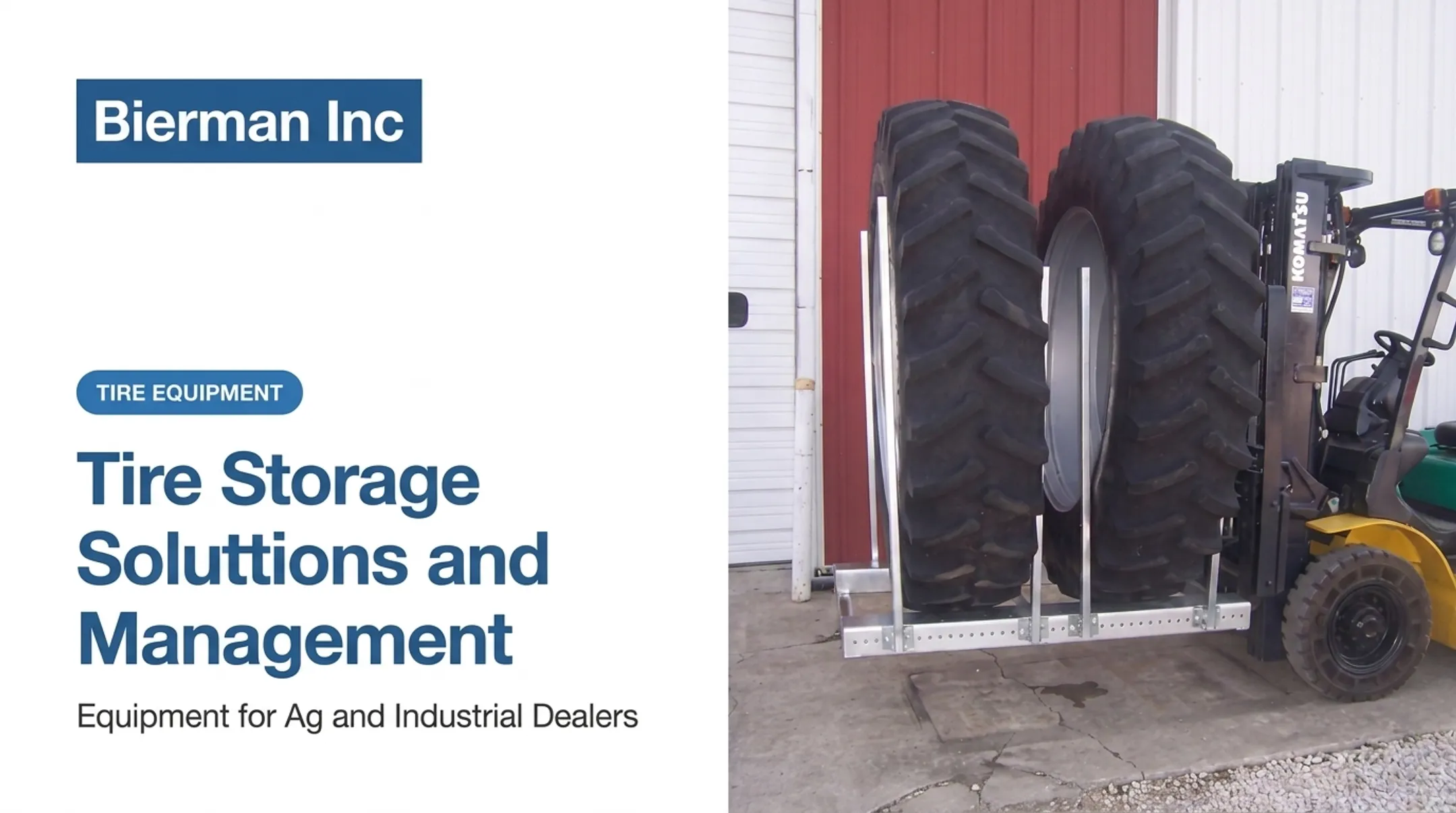
Bierman Inc built the EZ Dual Changer (Patent No. 9,695,020) to remove that bottleneck. It's a Made-in-the-USA tool that lets a single operator change dual tires in about five minutes, without first removing wheel weights. Key specs across the lineup:

- Holds up to 3,000 pounds, covering nearly any ag dual on the market
- Fits tire sizes from 14.9" to 32" across available models
- Rollers let the tire rotate smoothly for precise lug-nut alignment without re-lifting the wheel
- Model 51 handles 14.9", 18.4", and 20.8" tires (or 380-to-520 metric sizes) on hub-mount duals, rated to 1,500 pounds
- Models 830, 836, and 850 handle weighted or fluid-filled tires up to 1,500 pounds without removing the weights first
For heavier ag and industrial wheels beyond dual-changing, the Heavy Duty Ag Wheel Dolly carries loads up to 4,800 pounds. It is built for moving oversized assemblies around a shop floor, not just lifting them:
- 30-inch rollers for large-diameter wheels
- 12V over-hydraulic roller-width adjustment
- Three-position safety arm for controlled handling
The common thread across this equipment: nobody should be lifting an 800-pound wheel by hand, and nobody should need a second or third worker just to align lug nuts.
Frequently Asked Questions
What is the difference between a tire, a wheel, and a rim?
The wheel is the entire metal structure that bolts to the hub. The rim is just the wheel's outer lip, where the tire's bead seats. The tire is the rubber outer ring that holds air and contacts the road.
How do I know what size tires and wheels fit my vehicle?
Check the placard on the driver's side door jamb or your owner's manual. Both list the OEM-specified tire size, load rating, and inflation pressure. You can also match the size code stamped on your current tire's sidewall.
How often should tires be rotated and inspected?
Most passenger tires should be rotated every 5,000 to 7,500 miles. Combine that with a monthly visual check of tread depth and air pressure to catch uneven wear before it becomes a safety issue.
What is wheel offset and why does it matter?
Offset is the distance between the wheel's hub mounting face and its true centerline. Get it wrong, and the wheel can rub the suspension on the inside or the fender on the outside, even if the diameter and bolt pattern are correct.
How can farmers and technicians safely change heavy dual wheels?
Dedicated wheel-handling tools, like Bierman Inc's EZ Dual Changer, let one person lift, rotate, and align a dual wheel without manual lifting or a second set of hands. That cuts both injury risk and the time a tractor sits idle in the shop.